Faculdades presenciais ou EAD: which one is more worth it?

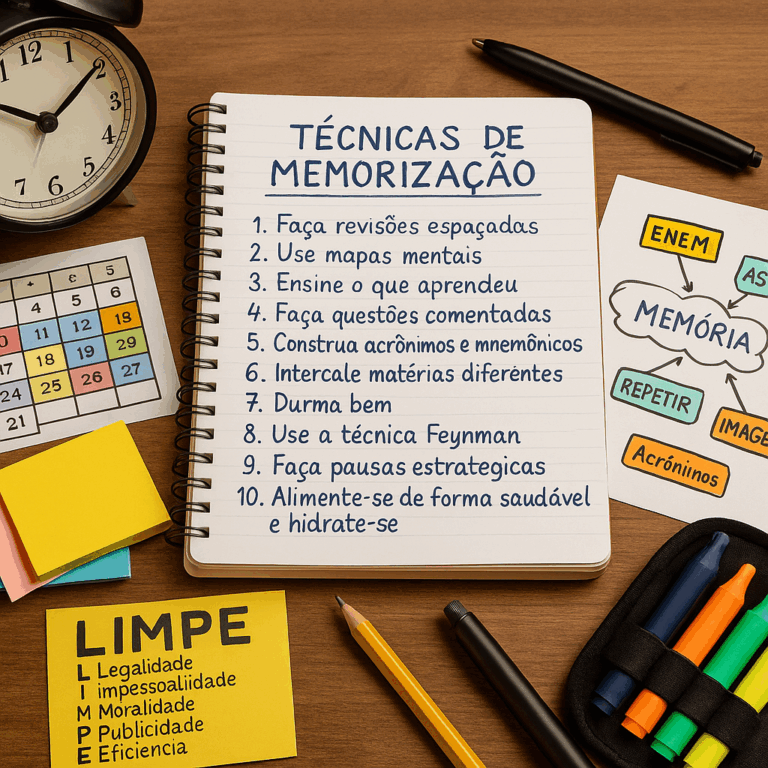
When there is a public competition, many people concentrate on passing the material, as follows: memorizar o conteúdo de forma actual. Memorization is a fundamental stage, a final stage, from which to study if you do not want to remember it at the moment of the test. The good news is that there are proven methods that can help your brain to retain information more quickly and in a more structured way. Shall we discover how?
Before learning the techniques, it is important to understand how the memory works. Our brain is forced to prioritize important information for survival and to discard what we consider "unnecessary". Therefore, repeating, reviewing and giving insight into what we are learning is fundamental.
In other words, factors such as stress, fatigue, power consumption and battery capacity are directly affected by memory capacity. Therefore, it is essential to keep your body and mind healthy during preparation.
The brain will experience a new challenge in a few days if it cannot be strengthened. A technique of Revisão Espaçada, based on the Ebbinghaus performance curve, propose to review it in strategic intervals:
This method reinforces the previous connections and makes it possible to remember the short lunch for a long lunch.
These mental maps help you visualize the content structure. By placing key words, sets, cores and associations, you create connections that your brain understands better than those long blocks of text.
Say to make a great mental map:
When you explain the conversation to someone, whether you are a colleague or someone else who speaks loudly, be sure to organize your thoughts and remember the details. It's a powerful way to fix the knowledge and perceive points that aren't clear yet.
If you can't do what you're doing, do a simple “mini seminar” right before I learn it.
Solve these anti-gas questions as the brain comes on reconhecer padrões and relation conceived in practice. Além said, to the comments of professors or relevant materials, strong voice or understanding.
If you err, great! If I make a mistake, it's an excellent opportunity to learn - you'll be reminded of the “alert” that you'll never forget again.
For complicated lists or concepts, invent acronyms or catchy phrases. This makes me think of you as a member of the association.
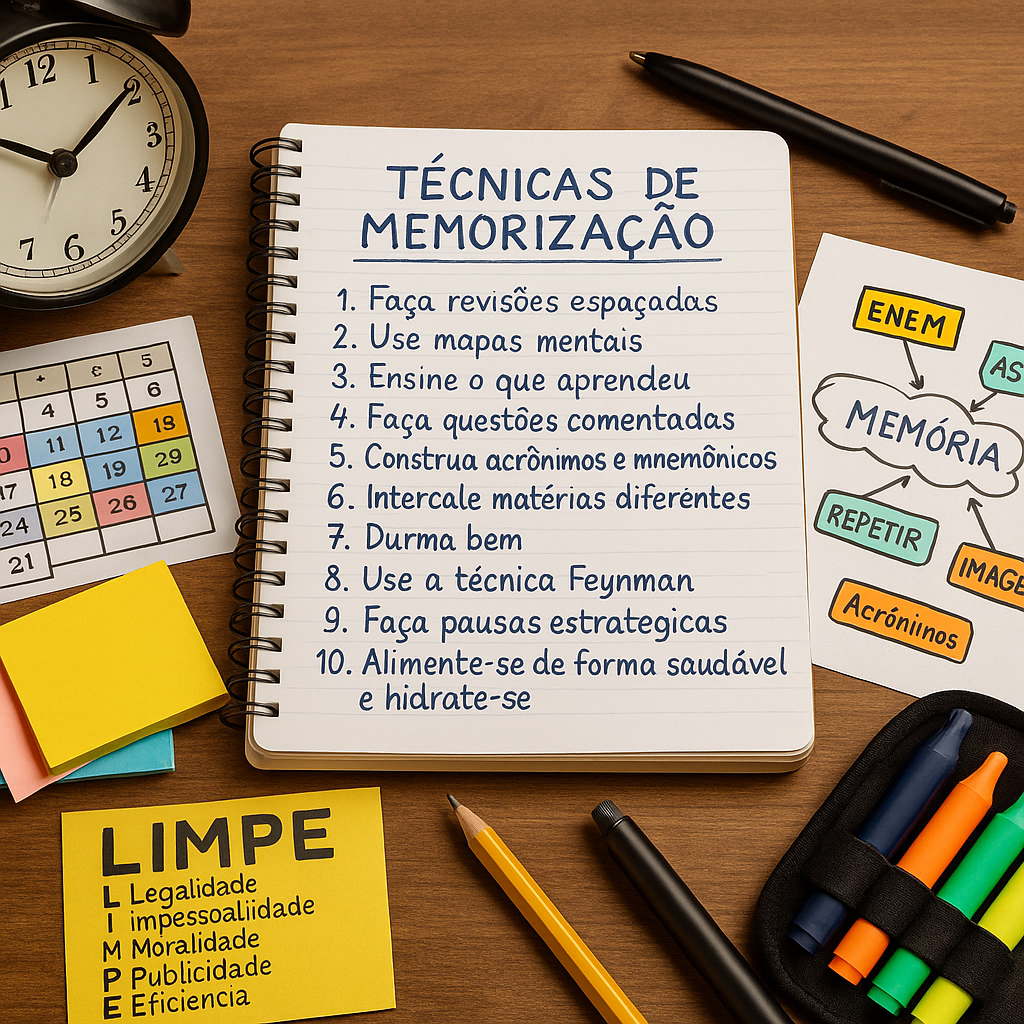
For example, in the Constitutional Directorate, to understand the principles of Public Administration (LIMPE):
Here in bank accounts, or “CESPE AMA PEGADINHA” to read common wardrobes in evidence.
Oh my brain, I enjoy variety. Studying such discipline over time can be beneficial and reduce retention. Alternate between different materials on the same day. For example: 1 hour of Portuguese, then 1 hour of Administrative Management, then 1 hour of Logical Reasoning.
Thematic “descanso” helps the brain to process and look better at the information.
While I am deep, the brain organizes and consolidates what I learned over the course of the day. Therefore, a good thing about me is as important as I am. Sleeping little is one of the biggest memory saboteurs.
Richard Feynman, Nobel Prize-winning physicist, said: “If you can't explain something simple, that's because you don't understand it.” Excreted or taken as if it were intended for a 12 year old. It obliges you to simplify the reasoning and understand what is wrong.
Studying for hours without pause is not efficient. Use the Pomodoro technique: sit for 25 minutes, rest for 5 minutes. After 4 cycles, take a longer break (15 to 30 minutes). This helps you keep your mind alert.
Your brain specifies fuel. Foods rich in omega-3 (peixes, seeds), fruits, vegetables and enough water help concentration and memory.
The memory cannot be counted for one day or another. It is a process that requires patience, repetition and intelligent techniques. How much more you treina seu cerebro, more strong ele pussy.
With these strategies, your preparation for the competition will be much more efficient - and you will understand that at the moment of testing, the answers will become much more clear.